


 sr
sr  ru
ru 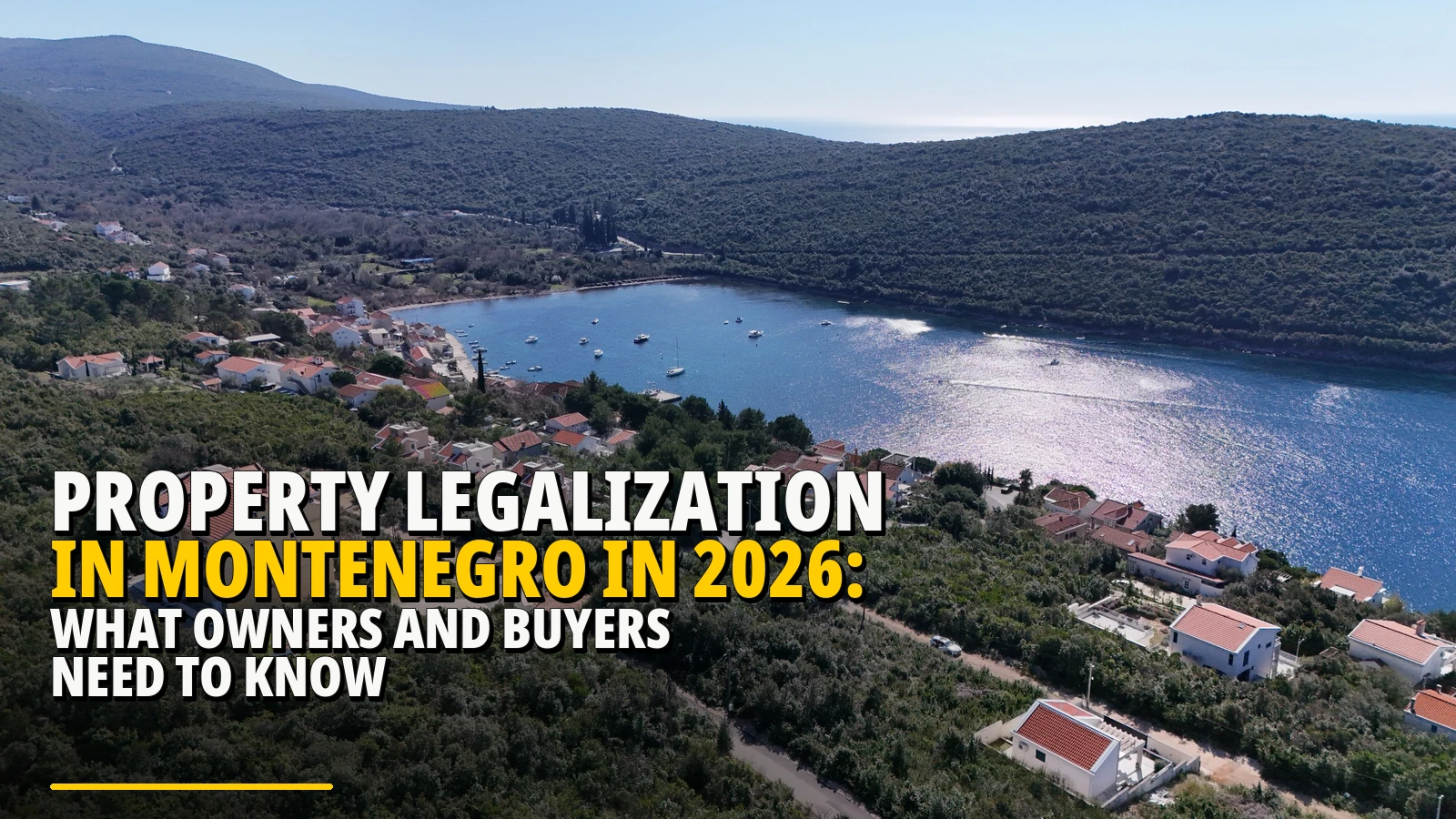
Property Legalisation in Montenegro in 2026: What Owners and Buyers Need to Know
Montenegro is continuing the legalisation of unauthorised buildings. The process is relevant not only to owners of houses, villas, apartments and commercial premises, but also to anyone considering buying property on the Montenegrin coast.
A property’s legal status matters just as much as its location, size, sea view and construction quality. A completed home may have been occupied for years while still differing significantly from the information held by the Real Estate Cadastre.
Owners of unauthorised buildings who have not yet started the registration process must apply to have their property entered in the Real Estate Cadastre by 14 August 2026.
The entire legalisation process does not have to be completed by that date. The deadline concerns the submission of the cadastral registration application, which is one of the main steps required before legalisation can proceed.
What the 14 August 2026 Deadline Actually Means
Montenegro’s Ministry of Spatial Planning, Urbanism and State Property has called on owners of unauthorised buildings to submit their registration applications within the statutory period.
Cadastral registration and legalisation are separate stages. Filing an application starts the process, but it does not mean that the property has already been legalised or that approval is guaranteed.
According to the Real Estate Administration, another important condition is that the building must appear on the satellite or aerial photogrammetric imagery produced in July 2025. Eligibility must therefore be checked for each property individually.
Which Properties May Be Affected
The issue is not limited to buildings that are completely absent from the cadastre. A house may be registered while its actual size, number of floors or layout differs from the official record.
Further investigation may be needed where:
- the house or other building is not recorded in the cadastre;
- the actual floor area is larger than the registered area;
- an additional floor was built later;
- extensions or extra rooms were added;
- an open terrace was enclosed and converted into living space;
- the layout or use of the premises differs materially from the approved documentation;
- a garage, swimming pool, storage room or another part of the property is not registered.
Checking the address and the owner’s name is not enough. The registered area, number of floors, permitted use and physical configuration of the property should all match what exists on site.
What Happens If the Application Is Not Submitted
The Ministry states that where cadastral registration has not been initiated within the statutory deadline, the spatial protection inspector is required to issue a removal decision.
An unclear legal status may also make it more difficult to:
- sell the property through a standard notarised transaction;
- register the new owner’s title;
- transfer the property through inheritance;
- reconstruct, extend or continue building;
- use the property as security for financing;
- resell or value the property with confidence.
Once a legalisation decision has been issued, the property obtains the legal status provided by law and can enter normal legal circulation, including sale, inheritance and permitted business use.
Why This Matters to Property Buyers
A buyer may have had nothing to do with the original construction, but any unresolved documentation issues can become their problem after completion.
An attractive price does not remove legal risk. A house or apartment may look finished, have water and electricity connections and have been occupied for many years, while still containing areas that were never properly registered.
Extra care is needed when a listing or seller includes statements such as:
- “the legalisation application has already been submitted”;
- “the property is currently being registered”;
- “the documents will be ready later”;
- “this part of the house is not yet in the cadastre”;
- “the neighbours are in the same situation”;
- “the extension can be registered after the purchase”.
These statements do not always mean that a purchase is impossible, but they do require proper investigation. Before paying a reservation fee or deposit, the buyer should know exactly what is registered, which restrictions apply and how far the procedure has progressed.
How to Check a Property’s Legal Status
The usual starting point is a current property sheet from the Real Estate Cadastre, known locally as the List nepokretnosti.
The document should be checked for:
- Ownership: who is registered as the owner and whether that person has the right to sell.
- The cadastral parcel: its number, area, designated use and registered rights.
- Building details: registered floor area, number of floors, use and individual parts.
- Encumbrances: mortgages, prohibitions, third-party rights and other restrictions.
- Official notes: entries concerning permits, legal status or possible irregularities.
The cadastral information must then be compared with the property itself. For example, the record may show a single-storey house of 100 m², while the actual building has two floors and a total area of 180 m². In that case, part of the building may not have been properly registered.
The status of the land, garage, parking space, storage room, terrace, swimming pool, access road and common areas should also be checked separately. Their inclusion in a property listing does not necessarily mean that they form part of the buyer’s registered ownership.
Can an Unauthorised Property Be Sold?
There is no single answer that applies to every property. Whether a transaction is possible depends on the cadastral record, registered restrictions, the stage of the legalisation process and which parts of the property are being transferred.
If the building is not registered or carries a restriction preventing legal transfer, a standard notarised sale may be impossible or involve substantial additional risk.
Before signing a preliminary agreement or accepting an alternative arrangement proposed by the seller, the buyer should establish:
- whether ownership can be registered in their name;
- whether the contract accurately describes the physical property;
- which rooms, buildings and parts of the land are legally included;
- whether legalisation could be refused;
- which costs and procedures may still be required;
- whether the property can later be resold without the same difficulties.
A purchase should be assessed on the basis of the property’s official status at the time of the transaction, not only on the seller’s assurances.
A Completed Property or a Bespoke Home
Buyers in Montenegro generally choose between a completed property and building a home of their own.
A finished apartment or villa allows the buyer to assess the architecture, layout, finishes, surroundings and views before purchasing. However, even a newly built or apparently completed property still requires a full documentation check.
Building a bespoke home offers greater control over:
- the location and choice of land;
- the size and number of floors;
- the internal layout;
- the inclusion of a pool, garage and additional rooms;
- the architecture, materials and building systems;
- whether the home is designed for permanent living, holidays or rental use.
A bespoke project should not begin with the first attractive plot on the market. The first step is to confirm what can legally and practically be built there.
What to Check Before Buying Land
A good sea view and a convenient location do not necessarily mean that a plot is suitable for the house you have in mind.
Before entering into a purchase, it is important to review:
- the designated use of the land;
- the applicable urban planning conditions;
- the permitted building area and number of floors;
- site coverage and development ratios;
- legally secured road access;
- the availability of utilities and connection options;
- the gradient, geology and likely earthworks;
- encumbrances, restrictions and third-party rights;
- existing or planned development on neighbouring land.
Two neighbouring plots can be subject to different building conditions. The development potential should therefore be assessed before a deposit is paid or the purchase agreement is signed.
Eco-Build Projects in Montenegro
Eco-Build develops and sells property in Montenegro. Our work covers not only architecture, views and construction quality, but also the documentation on which each project is based.
Before purchasing, clients can review floor plans, areas, specifications, site information, photographs, videos, technical details and the available legal documentation.
A buyer should understand exactly what is being purchased, which spaces form part of the registered property and which documents confirm its status. This makes it possible to assess the property on its merits rather than relying solely on the marketing description.
Turnkey House Construction in Montenegro
If none of the completed properties meets your requirements, Eco-Build can become involved while the land is still being selected and help assess whether a particular plot is suitable for the proposed house.
Our involvement may include:
- land search and preliminary plot assessment;
- analysis of development potential;
- architectural concept development and design;
- preliminary budgeting;
- organisation and supervision of construction;
- installation of mechanical and electrical systems;
- interior and exterior finishing;
- landscaping, swimming pools and additional structures;
- preparation of the completed home for handover.
The result is a home designed around the client’s requirements, from its location and layout to its materials, finishes and technical equipment.
Three Checks to Complete Before Buying
Whether you are purchasing an apartment, villa, house or plot of land, three areas deserve particular attention.
- Legal status. Ownership, cadastral records, restrictions, permits and whether the physical property matches the documents.
- Technical condition. Construction quality, building systems, materials, finishes and the general condition of the property.
- Practical potential. Suitability for permanent living, rental, resale, reconstruction or further development.
Particular caution is needed where legalisation is incomplete or there are significant differences between the documentation and what has actually been built.
Frequently Asked Questions
What is the deadline for submitting an application?
Must legalisation be completed by 14 August 2026?
How can I check whether a property has been legalised?
Can I buy a property while legalisation is in progress?
Should a property in a new development also be checked?
Can I build my own house in Montenegro?
Property with a Clear Legal Foundation
Legal status is not a technicality. It is one of the factors that determines a property’s real value. Before buying, you should know exactly what is included, whether the property matches its documentation and whether you will be able to use or sell it freely in the future.
Eco-Build offers completed projects in Montenegro and can also help assess land and deliver a bespoke turnkey home.
This article is provided for general information and does not constitute legal advice. Registration, legalisation and sale options must be assessed separately for each property using current documents and data from the Real Estate Cadastre of Montenegro.
Montenegro is continuing the legalisation of unauthorised buildings. The process is relevant not only to owners of houses, villas, apartments and commercial premises, but also to anyone considering buying property on the Montenegrin coast.
A property’s legal status matters just as much as its location, size, sea view and construction quality. A completed home may have been occupied for years while still differing significantly from the information held by the Real Estate Cadastre.
Owners of unauthorised buildings who have not yet started the registration process must apply to have their property entered in the Real Estate Cadastre by 14 August 2026.
The entire legalisation process does not have to be completed by that date. The deadline concerns the submission of the cadastral registration application, which is one of the main steps required before legalisation can proceed.
What the 14 August 2026 Deadline Actually Means
Montenegro’s Ministry of Spatial Planning, Urbanism and State Property has called on owners of unauthorised buildings to submit their registration applications within the statutory period.
Cadastral registration and legalisation are separate stages. Filing an application starts the process, but it does not mean that the property has already been legalised or that approval is guaranteed.
According to the Real Estate Administration, another important condition is that the building must appear on the satellite or aerial photogrammetric imagery produced in July 2025. Eligibility must therefore be checked for each property individually.
Which Properties May Be Affected
The issue is not limited to buildings that are completely absent from the cadastre. A house may be registered while its actual size, number of floors or layout differs from the official record.
Further investigation may be needed where:
- the house or other building is not recorded in the cadastre;
- the actual floor area is larger than the registered area;
- an additional floor was built later;
- extensions or extra rooms were added;
- an open terrace was enclosed and converted into living space;
- the layout or use of the premises differs materially from the approved documentation;
- a garage, swimming pool, storage room or another part of the property is not registered.
Checking the address and the owner’s name is not enough. The registered area, number of floors, permitted use and physical configuration of the property should all match what exists on site.
What Happens If the Application Is Not Submitted
The Ministry states that where cadastral registration has not been initiated within the statutory deadline, the spatial protection inspector is required to issue a removal decision.
An unclear legal status may also make it more difficult to:
- sell the property through a standard notarised transaction;
- register the new owner’s title;
- transfer the property through inheritance;
- reconstruct, extend or continue building;
- use the property as security for financing;
- resell or value the property with confidence.
Once a legalisation decision has been issued, the property obtains the legal status provided by law and can enter normal legal circulation, including sale, inheritance and permitted business use.
Why This Matters to Property Buyers
A buyer may have had nothing to do with the original construction, but any unresolved documentation issues can become their problem after completion.
An attractive price does not remove legal risk. A house or apartment may look finished, have water and electricity connections and have been occupied for many years, while still containing areas that were never properly registered.
Extra care is needed when a listing or seller includes statements such as:
- “the legalisation application has already been submitted”;
- “the property is currently being registered”;
- “the documents will be ready later”;
- “this part of the house is not yet in the cadastre”;
- “the neighbours are in the same situation”;
- “the extension can be registered after the purchase”.
These statements do not always mean that a purchase is impossible, but they do require proper investigation. Before paying a reservation fee or deposit, the buyer should know exactly what is registered, which restrictions apply and how far the procedure has progressed.
How to Check a Property’s Legal Status
The usual starting point is a current property sheet from the Real Estate Cadastre, known locally as the List nepokretnosti.
The document should be checked for:
- Ownership: who is registered as the owner and whether that person has the right to sell.
- The cadastral parcel: its number, area, designated use and registered rights.
- Building details: registered floor area, number of floors, use and individual parts.
- Encumbrances: mortgages, prohibitions, third-party rights and other restrictions.
- Official notes: entries concerning permits, legal status or possible irregularities.
The cadastral information must then be compared with the property itself. For example, the record may show a single-storey house of 100 m², while the actual building has two floors and a total area of 180 m². In that case, part of the building may not have been properly registered.
The status of the land, garage, parking space, storage room, terrace, swimming pool, access road and common areas should also be checked separately. Their inclusion in a property listing does not necessarily mean that they form part of the buyer’s registered ownership.
Can an Unauthorised Property Be Sold?
There is no single answer that applies to every property. Whether a transaction is possible depends on the cadastral record, registered restrictions, the stage of the legalisation process and which parts of the property are being transferred.
If the building is not registered or carries a restriction preventing legal transfer, a standard notarised sale may be impossible or involve substantial additional risk.
Before signing a preliminary agreement or accepting an alternative arrangement proposed by the seller, the buyer should establish:
- whether ownership can be registered in their name;
- whether the contract accurately describes the physical property;
- which rooms, buildings and parts of the land are legally included;
- whether legalisation could be refused;
- which costs and procedures may still be required;
- whether the property can later be resold without the same difficulties.
A purchase should be assessed on the basis of the property’s official status at the time of the transaction, not only on the seller’s assurances.
A Completed Property or a Bespoke Home
Buyers in Montenegro generally choose between a completed property and building a home of their own.
A finished apartment or villa allows the buyer to assess the architecture, layout, finishes, surroundings and views before purchasing. However, even a newly built or apparently completed property still requires a full documentation check.
Building a bespoke home offers greater control over:
- the location and choice of land;
- the size and number of floors;
- the internal layout;
- the inclusion of a pool, garage and additional rooms;
- the architecture, materials and building systems;
- whether the home is designed for permanent living, holidays or rental use.
A bespoke project should not begin with the first attractive plot on the market. The first step is to confirm what can legally and practically be built there.
What to Check Before Buying Land
A good sea view and a convenient location do not necessarily mean that a plot is suitable for the house you have in mind.
Before entering into a purchase, it is important to review:
- the designated use of the land;
- the applicable urban planning conditions;
- the permitted building area and number of floors;
- site coverage and development ratios;
- legally secured road access;
- the availability of utilities and connection options;
- the gradient, geology and likely earthworks;
- encumbrances, restrictions and third-party rights;
- existing or planned development on neighbouring land.
Two neighbouring plots can be subject to different building conditions. The development potential should therefore be assessed before a deposit is paid or the purchase agreement is signed.
Eco-Build Projects in Montenegro
Eco-Build develops and sells property in Montenegro. Our work covers not only architecture, views and construction quality, but also the documentation on which each project is based.
Before purchasing, clients can review floor plans, areas, specifications, site information, photographs, videos, technical details and the available legal documentation.
A buyer should understand exactly what is being purchased, which spaces form part of the registered property and which documents confirm its status. This makes it possible to assess the property on its merits rather than relying solely on the marketing description.
Turnkey House Construction in Montenegro
If none of the completed properties meets your requirements, Eco-Build can become involved while the land is still being selected and help assess whether a particular plot is suitable for the proposed house.
Our involvement may include:
- land search and preliminary plot assessment;
- analysis of development potential;
- architectural concept development and design;
- preliminary budgeting;
- organisation and supervision of construction;
- installation of mechanical and electrical systems;
- interior and exterior finishing;
- landscaping, swimming pools and additional structures;
- preparation of the completed home for handover.
The result is a home designed around the client’s requirements, from its location and layout to its materials, finishes and technical equipment.
Three Checks to Complete Before Buying
Whether you are purchasing an apartment, villa, house or plot of land, three areas deserve particular attention.
- Legal status. Ownership, cadastral records, restrictions, permits and whether the physical property matches the documents.
- Technical condition. Construction quality, building systems, materials, finishes and the general condition of the property.
- Practical potential. Suitability for permanent living, rental, resale, reconstruction or further development.
Particular caution is needed where legalisation is incomplete or there are significant differences between the documentation and what has actually been built.
Frequently Asked Questions
What is the deadline for submitting an application?
Must legalisation be completed by 14 August 2026?
How can I check whether a property has been legalised?
Can I buy a property while legalisation is in progress?
Should a property in a new development also be checked?
Can I build my own house in Montenegro?
Property with a Clear Legal Foundation
Legal status is not a technicality. It is one of the factors that determines a property’s real value. Before buying, you should know exactly what is included, whether the property matches its documentation and whether you will be able to use or sell it freely in the future.
Eco-Build offers completed projects in Montenegro and can also help assess land and deliver a bespoke turnkey home.
This article is provided for general information and does not constitute legal advice. Registration, legalisation and sale options must be assessed separately for each property using current documents and data from the Real Estate Cadastre of Montenegro.